
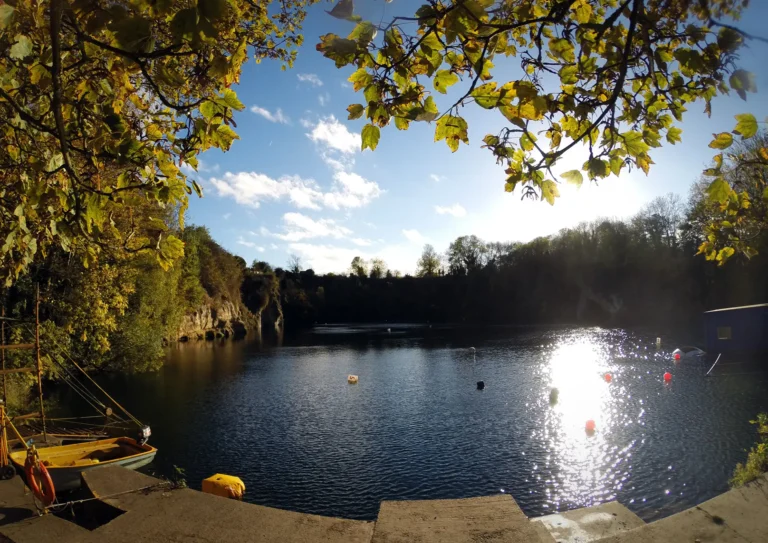
Inland diving often gets dismissed as a backup plan for days when the sea is blown out, but anyone who spends time in quarries and lakes knows there is far more to it. These sites are full of character. They have their own ecosystems, their own quirks and their own hidden landmarks. Sunken boats, aircraft, cars and training platforms turn a simple dive into a small adventure. They give you something to navigate to, something to explore and something to learn from.
Why These Attractions Matter
Freshwater sites can feel featureless at first glance. Visibility changes from week to week, the bottom can be silty, and natural structures are not always obvious. Purpose sunk attractions solve that problem. They give divers fixed points to work with and they help you build confidence in navigation, buoyancy and communication.
They also make training more interesting. A platform at six metres is a far better place to practise skills than kneeling in silt. A sunken boat gives you a chance to work on controlled approaches and stable hovering. A plane fuselage teaches you how to manage tight spaces without stirring up the bottom.
Sunken Boats: Simple Shapes with Plenty to Offer
Boats are the most common inland attraction and for good reason. They are easy to sink, easy to maintain and easy to navigate around. Most are stripped of hazards and left open so divers can explore safely.
What to look for:
- Clear entry and exit points
- Areas where silt collects
- Lines that lead to and from the wreck
- Wildlife that has made the structure home
Boats are perfect for practising trim and buoyancy. You can swim the length of the hull without touching anything and use the structure as a reference point for depth control.
Planes: The Big Draw for Many Divers
There is something special about dropping down through green water and seeing the outline of a plane appear beneath you. Even small training aircraft feel dramatic underwater. They offer a different kind of challenge because the shapes are more complex and the spaces are tighter.
How to approach them:
- Stay slow and controlled on the descent
- Keep your fins high to avoid stirring up the bottom
- Use the wings as a stable reference point
- Avoid squeezing into areas that feel too tight
Planes attract a lot of interest, so good awareness of other divers is essential. It is easy to get caught up in the moment and forget how many people are around you.
Training Platforms: The Unsung Heroes of Inland Diving
Platforms might not sound exciting, but they are the backbone of most inland sites. They give instructors a safe, predictable place to run skills and they give qualified divers a reliable point to return to.
Why they matter:
- They help you practise controlled ascents and descents
- They are ideal for mask skills, buoyancy drills and valve checks
- They make navigation easier because they are usually linked by lines
Platforms are also a good place to pause, check your gas, settle your breathing and plan the next part of your dive.
Making the Most of These Attractions
To get the best out of inland attractions, treat them as more than sightseeing spots. Use them to build habits that will serve you well in open water.
Try this approach:
- Plan a simple route that links two or three features
- Practise navigation between them using compass and natural cues
- Hover beside structures without touching them
- Watch how other divers interact with the site and learn from what they do well
The more you use these attractions with purpose, the more your confidence grows.
A Different Kind of Adventure
Inland diving is not a compromise. It is a different environment with its own rewards. Sunken boats give you structure. Planes give you drama. Platforms give you consistency. Together they turn a quarry or lake into a training ground that can sharpen your skills for any dive you want to do in the future.
If you approach these sites with curiosity and respect, you will find that every dive has something to teach you. And that is what keeps inland diving interesting long after the novelty wears off.
If you want, I can also create a shorter version for social media, a companion post on buoyancy control around structures, or a guide to the best inland sites in the UK.